Showing posts with label guerilla marketing. Show all posts

Thursday, 8 September 2016

A hierarchy of value when everything functions and what that means for your #startup

This Blog from Seth Godin again hits the nail on the head. 
With such certainty and precision that I have to pop it down here. 
His point is a great one - that a business decides by action or by non action where it is on the ladder. 
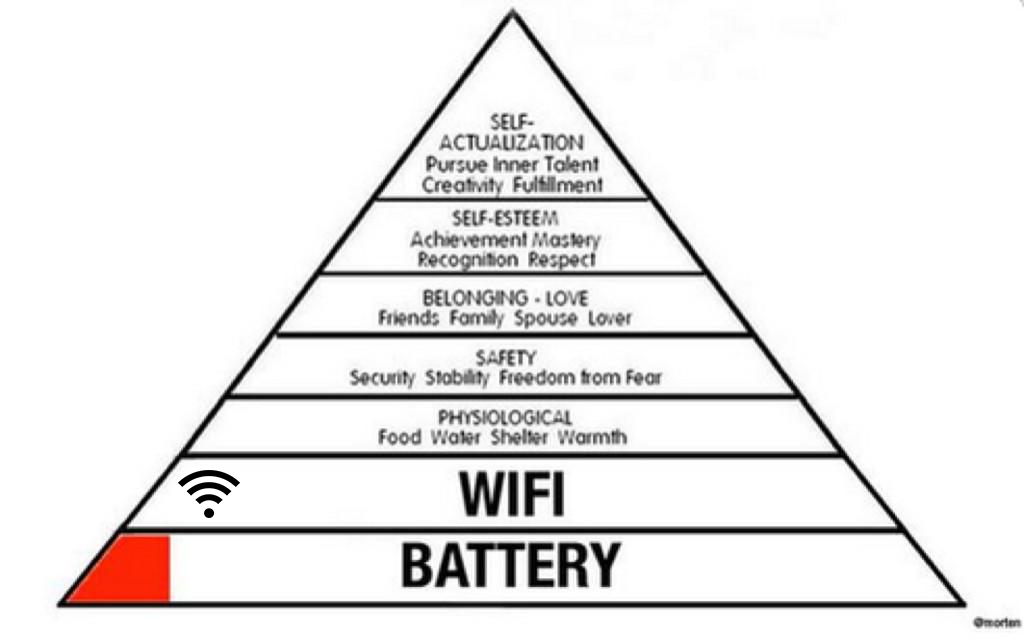
It's like a customer version of Maslow's hierarchy of needs. 
See below for a lovely modern take on this...
Image result for the modern hierarchy of needs
But Seth's point is more serious... and really apt considering it was Apple's annual launch day. 
A company that through it's marketing and design has changed the conversation and ecosystem around telecomms more than any other. See his point on smartphones later on. 
The reason I include it here is his point about freelancers 
"Most freelancers have been so beaten down in the quest to make a go of it, they stop at function and take what they can get."
Which in some way is a trap I am falling into. My training company Great Marketing Works didn't do that - we had connection and style. 
Perhaps my freelancing as a consultant does as well? We have some great gigs coming up. 
I want to have the audacity to redefine 'function' (see his end conclusion...) 

I hope for your startup you decide to do the same - or at least do something with style.... 
Here's to doing that and here's to Seth Godin's A hierarchy of value when everything functions

When two things offer simply the same appropriate level of function, we'll choose the cheap one.
Hierarchy of value
But if one offers more connection than the other, it is worth more. 
This hotel over that one. Where is the tribe, do people like me do things like this, who's there, will they miss me, do I trust them, have I been here before...
If two items offer connection, but one offers the approval and sexiness that style brings, some of us will pay extra for that. After all, style promises ever more connection.
And at the top of the hierarchy is our quest for scarcity, desire and the hotness of now. 
In a market like smartphones, it's pretty clear that it's really difficult to offer more function than the other guy. And the quality of connection, the very attribute that fuels the smartphone, was surrendered to the app makers a long time ago. Which leaves the sexiness of a drop-dead case and the urgency of the latest model.
What do you and your team offer? Where are you in the hierarchy?
Most freelancers have been so beaten down in the quest to make a go of it, they stop at function and take what they can get. Some businesses (small and large) find the patience and guts to offer connection or even style. And every once in awhile, an idea and an organization come along that promise to share the elusive hot that sits atop the pyramid.
So, buy a Harley, not because it can move you from here to there cheaper, but because it comes with a tribe. And buy that Nars lipstick because of the way it makes you feel. And get on line for that new gadget, because, hey, there's a line.
And then, someone finds the audacity to redefine 'function' and the whole thing begins again.

Friday, 27 June 2014

How could use Disruptive Innovation to advance your thinking and your career?

A really nice blog from 
Jeff is an expert in the Enterprise Content Management industry. He brings over 20 years of Channel Sales, Partner Marketing and Alliance expertise to audiences around the world in speaking engagements and via his writing. 

He has worked for Microsoft, Kodak, K2 and Gimmal. Follow him on Twitter @jshuey or on LinkedIn: in/JeffShuey
The blog is all about how could use Disruptive Innovation to advance your thinking and your career?
It's quite funny as without realising it - I have been doing this for years. Now it has a name - I will double my efforts by doing it consciously, see below ... 
"First, let’s think about what Disruptive Innovation (otherwise known as DI) means.
disruptive innovation is an innovation that helps create a newmarket and value network ~via Wikipedia
Using DI thinking can certainly impact long held business models. A few business that have been impacted by Disruptive Innovations are listed below and followed by some of the businesses that stepped in to replace them.
  • Tower Records –> Napster (now Pandora, Spotify, iTunes and many others)
  • Blockbuster –> Netflix, Amazon Prime, etc.
  • Travel Agents / Agencies –> Expedia, Kayak, et al
In the first example the original disruptive innovator, Napster, has already been DI’d by new entrants. Which only proves the point that DI thinking is an effort that never ends. Very much like your career. You need to constantly be on the lookout for a different way to do something.
You could argue that Uber - the DI of the taxi industry is going to be DI'ed by Justaxi - the Manchester cheeky up start / start up. 
However, the same principles can be applied to your Career Development. For example:
  • In education: Instead of 4 years for university –> Consider MOOC’s.
  • (Which is what I did to learn about gamifaction with University of Penn) 
  • Instead of climbing the corporate ladder –> Create your own ladder
  • (Which is what I am going to do with my own mobile games company) 
  • In lieu of solving the same old problems –> Develop new ways of thinking that focus on higher value customer needs
  • (Again my plan for mobile games - that can become gifts for people....) 
First, seek to understand the business you are really in. Make no mistake… a career is a business. It’s the most important business you will ever invest your time and energy into and you’ll be doing it for a long time. So, make the most of it.
To understand your business and to think a little more sideways you should start by asking different questions, experimenting with new models, and looking for different ways to add value in ways that have not been considered.
For example, if you went to school to become an engineer:
  • What are you actually creating?
  • What benefit are you really delivering?
  • Are there different ways you can deliver value to the customer?
These same questions can be applied to almost any career. Whether you studied accounting, drama or zoology.

Seek to Out Innovate Yourself

This may seem like an oxymoron, but when you think about it you need stay ahead of the competition. Where the competition is not necessarily the person in the cube next to you. The competition is yourself. 
You want to do more tomorrow. But, you don’t always need to work longer hours. The old cliché is true here… you want to Work Smarter, Not Harder. When you do your ability to brand yourself as an innovator will be preceded by your ability to think differently, ask tough questions and deliver stellar results."
Wise words Jeff - which is why I popped then up here... 

Monday, 13 January 2014

Born or made? Entreprenurs. Discuss.

After a rather turbulent Christmas and New Year. I have been left asking myself about employment vs. entrepreneurship. Whether you really can be an "intrapreneur" and in truth, whether I have a mental problem or something wrong with me. The reason being is that I have left my rather stable world of employment to work as a consultant for a start up once again. This despite knowing the risks involved. 

And you know what..... I couldn't be happier. Well I would be happier if my last employer and I can see eye to eye on the subject of some money still owed to me - rather a large amount as it happens. 

It is this disagreement again and the fact they didn't seem to see it as a problem that prompted my leaving, not the team I left, not the ideas that we had, not the speed of progress made, not the changing of the world or the changing of the seasons. 

Yet, something deep inside me puzzled me about my leaving, so it was with interest that I read the below about entrepreneurship, as it might just be that I don't have a mental problem, it might just be a gene inside me, a gene, called the e gene.  

Recent research by Amway has revealed that, to become a successful entrepreneur, you must be in possession of the 'e-gene', which is categorised by six different personality traits as identified by Chris Coleridge, an innovation researcher at the London School of Economics. And you see - I have several of them - if not all of them.... to an extent. 

The six traits of entrepreneurship are: 

Difficult background - left on a doorstep when I was two, taken into two care homes, adopted by a loving family (of a different race and religion)

Minority/disadvantaged group - originally rather poor - mixed race - luckly adopted see above.

Disability - mild dyslexia (yes I couldn't spell that without spell check - why is that word so silly anyway!  I also wear glasses (very strong ones) and I am a bit odd socially (great on stage but not in groups.)

Risk-lover and optimist - I would say the latter rather than the former, but looking back on it - not starting a career till 36 and always running my own businesses from 16 probably says "risk" 

Independence and social distinction - fiercely so  to the extent it has become a disability (see above) and what else motivates a man to write a blog like this :)

The need for achievement and power- again former rather than the latter. (See above see above)
However, an important distinction it that - power is something - I care not one jot for - and am a firm believer that power simply corrupts - the less of it in the hands of men the better (and I do mean men here not men as mankind.) The more power to the people rather than to man made bureaucracies (and again I mean man made not woman made.) 

Coleridge argues that a combination of these six traits can be identified in all "successful" entrepreneurs. Which brings up the subject of success which creates another points. As many / most entrepreneurs are failures for a long time, some argue that it is that ability to be a failure in the eyes of the world and still love what you do, still continue, still work at it and become successful that is another characteristic (and even a necessary part of the process.)

But isn't this the same of all artists and creators? When looking into the "Over night success stories" from musicians to comedians you often see the magic 10 years and the irony of them being called over night successes.  However, back to Coleridge's e-gene traits. According to the research, Richard Branson has four of the traits – disability, risk-lover and optimist, independence and social distinction, and need for achievement/power, whilst Anita Roddick, founder of The Body Shop, possesses three - difficult background, minority/disadvantaged group, and independence and social distinction.

"Having researched entrepreneurs' personalities and traits, most of the successful possess an effectual logic – an approach to solving a problem that starts not with the desired end but with the available means, limiting the risk of failure," he adds.

Which pretty much sums me up.

And for the record I have all six traits - which cannot be healthy. 

But not everyone agrees (which is good otherwise the world would be boring) as serial entrepreneur Jonathan Richards believes that an entrepreneurial mindset is the sum of all our experiences and it is not something that we are born with.

"An entrepreneur is created when an idea comes together with a person who is happy to balance creativity and management; understand, live with and manage risk; evangelise the idea in the face of negativity; and stay responsive and positive," he says.

However, if you see the six traits, less than half are you born with. 

Former Dragons' Den judge and founder of School for Startups Doug Richard also believes that nobody is ‘born’ an entrepreneur and that entrepreneurship can most definitely be taught.

But he would as he teaches it. And very well might I add. Sometimes with my help.

What Doug says is...

"If you give a group of people a violin, certain people will have a natural ability of course, but that becomes irrelevant if everybody is given a chance to learn and practice. We all need to do exactly that in whatever we choose to do professionally or otherwise. Nobody can claim to be born an entrepreneur, and nobody wakes up one day with a successful business and brand. Hard work, mistakes and a determined attitude combined with the right support at the right time are the not-so-magic formula."

After reading the Outliners book and others it would seem that 10,000 hours should do the trick and then everyone would be entrepreneurs. The problem with this thinking is that some personality types, many of whom I have met now as I have had a job, simply wouldn't want to ever become a entrepreneur.

Perhaps entrepreneurship it is like greatness. Some are born great, some make themselves great and some lucky ones through clever marketing and PR have greatness thrust upon them! :)

Either way it is with the spirit of an entrepreneur I create my consultancy contract for working with a geo location mobile software specialist start up called Justaxi.  They have a great technology, an eager investment team, some real pedigree in entrepreneurship on the board, a great culture and new team (lead by me) and an amazing £1 billion market to aim at.

I am going to do their marketing and business development, bringing in social and mobile, maybe even a bit of augmented reality, definitely some gamification for the app experience and loads of digital guerrilla marketing ... as a consultant at first.... but you never know I might let them employ me :) 

Wednesday, 6 June 2012

Worth thinkg about after a training session with New Directions - 7 Ways to Disrupt your Chosen Industry

I just finished a rather lovely trainig half day with MMU and some fine students who wish to take a New Direction in life and maybe start their own businesses.

I was, of course, talking mainly about guerrilla marketing and the amazing changes that digital marketing and mobile marketing are bringing to the world.

I then read the below from Fast Company - and loved it so much - I had to pop it below. So there you go.

To all of your reading this blog from New Directions - congrats to you and good luck with the new year ahead.

Just remember... Massive disruption is coming, and the only question is whether your idea is going to cause it or fall victim to it. Disruption is not easy--either to create or to confront. We have no illusions about that.

But in the spirit of helping established firms best serve their customers, we offer seven ways your firm could disrupt its own industry, raising the standards of customer experience and creating new opportunities for growth:

1) Totally eliminate your industry’s persistent customer pain points.

Each industry has practices that drive customers crazy.

Technology providers drive customers crazy with technical support that often requires long waits on hold and hopelessly complex interactions (“Just find the serial number on the back of your device and type that into the space provided along with your IP address and the exact wording of the error message you encountered”).

Unsurprisingly, this is the exact type of practice that causes customers to believe a company is behaving stupidly.

What practices exist in your industry that drive customers crazy? How do all companies in your industry behave stupidly? Identify these types of practices, and wipe them out.

Think: can we turn our process or perspective around, to look through the customer’s eyes as though they were the company and we were the customers?

2) Dramatically reduce complexity.

As we write this in November 2011, a company we have been tracking for some time--Simple, formerly known as BankSimple--is trying to take a machete to the insanely complex and confusing world of consumer banking.

Recognizing that banks do a pretty good job of managing money but a poor job of managing customers, Simple has been designing vastly simpler customer interfaces and tools.

Simple plans to partner with, not compete against, established banks. They’ll manage the customers while their banking partners manage the money.

The more complex the processes and practices in your industry, the greater your opportunity to gain competitive advantage by simplifying them. Yes, doing so will be very hard. But that’s the whole point; the first firm to do so gains tremendous advantages.

3) Cut prices 90 percent (or more).

Incremental change doesn’t disrupt an industry; radical change does. Radical price reductions require radical new processes and business models. Smartphones and tablets create numerous opportunities to identify these. Recently we replaced a $500 marine navigation unit with a $20 iPad app that works better.

You don’t cut prices by 90 percent through marginal improvements in existing products. You do it by asking, “What problem are we trying to solve for the customer, and how do these disruptive forces create opportunities for us to solve it in a far more efficient manner?”

4) Make stupid objects smart.

We didn’t think this one up. The race is on to make everything smart, and the dumber your products were to begin with, the greater the opportunity to make them smart.

Think of a garbage dumpster that calls central dispatch when it is full, eliminating the need for the customer to do so or your office to send a driver out unnecessarily. That same dumpster could warn the customer when it is overweight, and point out that it would be cheaper to empty it now than to further overfill it.

No offense to dogs, but their collars could alert owners when the dog wanders away, barks excessively, or jumps on the furniture.

Light bulbs could flash before they burn out. Baseballs could announce how fast they were thrown. Plants could politely request water when they are too dry, or shout out when you try to overwater them.

Take every product you sell, and make it smart…or accept the fact that you must forever more compete on price and accept low margins.

5) Teach your company to talk.

Apple's Siri personal assistant on the iPhone allows you to have a conversation with your phone. Your iPhone can now access the Internet as well as the information it stores, both understanding and responding appropriately to your statements.

Flash-forward two to five years from now. What if your company could talk to customers? We don’t mean that your employees talk on behalf on the company. We mean that a digital, computerized persona speaks on behalf of your firm.

It takes orders. It provides support. It answers questions. It upsells. It issues refunds. All of this, and more, in response to verbal requests by customers.

The toughest part of this challenge is not technical, although a few problems still need to be solved.

The tough part is knocking down the walls that separate your databases and departments. It’s deciding whose product gets cross-sold, who gets “credit” for sales, and who “owns” the customer.

Our view is simple. No one owns the customer, and you either do what’s best for the customer or you will lose him. But the real question we want to put forward is this: what happens if your competitors’ companies talk, but yours doesn’t?

6) Be utterly transparent

Think: not just no secrets, but also no spin.

The concepts of social influence and pervasive memory will make it increasingly difficult for companies to hide from dissatisfied customers, negative reviews, and faulty products.

What if your company didn’t simply try to stop hiding, but instead radically embraced the truth? How might it impact your culture to decide that your firm would be the most powerful force in your industry making certain that every speck of the truth was obvious to every customer, analyst, and reviewer?

Would it change your reward systems? Would it impact employee motivation? Might it cause changes in the kind of employees you attract and retain?

We’re pretty opinionated in this regard. The truth is coming, and there’s nothing you can do about it. But most firms won’t recognize this until it happens. Better to get far out in front while confusion reigns.

7) Make loyalty dramatically easier than disloyalty.

According to Don Clark writing in his Wall Street Journal blog, Intel executive Mooly Eden once asked an audience how many had cellphones, and then how many were married.

Then, he asked if any of the married people would be willing to hand over their phone if their spouse lost his or hers. None would. “That is my point,” said Eden. “That is personalization.” By definition, when companies act smart they are personalizing the way they interact with and serve customers. Once you start delivering personalization, you create immense opportunities to make loyalty more convenient than disloyalty:

You can store customer preferences, and act on them.
You can save the customer time, money, or effort--especially by eliminating repetitive tasks.
You can provide auto-replenishment of needed supplies.
You can monitor products remotely, and service them before they break instead of afterwards.

Think about every major purchase decision your customers face in your industry. How can you make it easier for customers to remain with your firm? Now, think even bigger. Can it be five or ten times easier? Subtlety can be lost on today’s customers.

The challenge is to make loyalty so much more convenient, so radically easy, that customers won’t even consider switching to a competitor. Ever.
Tuesday, 29 November 2011

Turning inexperience into an asset.

Some lovely wise words from Richard Branson - all about the key to turning inexperience into an asset.

He thinks it is to pitch what is new about your product or service. Classic #greatmarketing.

How does your approach differ from that of other businesses? How will you reach out to target markets?Some Why should people choose your products and services over your competitors'? Present prospective partners with a fresh take on a tired industry, and you will grab their attention.

I really hope this is the case - as this is what we are trying to do with goAugmented - based up in Manchester - and the UK's only award winning AR company.

Our group's history has taught us to target new industries and markets where we feel we can add something new, improve the customer's experience and carve out a successful position. Our move from publishing into music retailing is a case in point. When we sensed that Student magazine's circulation was reaching its peak, we looked for more ways to make money, and decided to start selling records by mail order. A postal strike stopped the business in its tracks, but we had caught the music bug. Instead we set up our first record store. So our inexperience did cause us a near-miss, and it's likely that if people are asking you about your lack of experience, your ability to spot problems is on their minds. But many startups fail each year; a founder's background has little correlation with success. A couple of failures on a beginning entrepreneur's record should not be considered an issue. Indeed, investors need to become better at accepting that as our dynamic, innovative economy constantly reinvents itself, businesses will inevitably become obsolete. A young entrepreneur who has dusted himself off and started again, learning from his mistakes, has proved that he has what it takes.

Constrained by a lack of capital after the strike, we found a former shoe shop on Oxford Street in London, and we talked the owner into letting us use the empty space. We were not trained retailers, but we liked music and wanted to create a cool hangout for young people. Instead of building displays designed to move merchandise quickly, with huge racks of records and no place to sit down, we brought in big, comfy cushions and built listening booths -- it was a place where you could chat about music with your friends and share your favorites with them.

All this added to the Virgin Brand experience - so perhaps sometimes having little money and no experience is a good thing. Great news for a lot of my clients :)